



The Short Version
A cockerel that has stood on the shirt since 1921, a set of cashmere tops the players thought were lucky, and a centenary shirt sold without a sponsor's name in sight. Here is the story of Tottenham Hotspur's shirts, from the 1930s to today, and the moments that turned specific kits into genuine club history.
In this article
- The cockerel, the motto and the lucky shirts
- The Double, and the classic Umbro look
- Ardiles, Villa and the centenary kit
- The shirt worn only once
- The Hummel years, and the swansong that never came
- Puma, Under Armour and the move to Nike
- Collecting Tottenham shirts
- Owning one
- Frequently asked questions
Some clubs are defined by a single unforgettable shirt. Tottenham Hotspur's story runs deeper than that: a crest with more than a century of continuous history, a set of shirts the players genuinely believed were lucky, and a kit sold without any sponsor at all that has become one of the most sought-after pieces in English football. Here is the story of the Spurs shirt, and the moments that turned it into genuine collecting history.
The Cockerel, the Motto and the Lucky Shirts
Tottenham's cockerel standing on a ball has appeared on the shirt continuously since 1921, paired with the club's Latin motto, Audere est Facere, to dare is to do. Few crests in English football have stayed so consistently central to a club's identity for so long, even as the shield and detailing around it have changed repeatedly across the decades.
One of the stranger chapters in that history came in 1930, when a new, rounder version of the crest was introduced on off-white cashmere shirts with white cotton collars. Those cashmere tops were only meant to be worn for part of the season, but the team took to changing into them at half-time during matches, a habit that became so associated with a change in fortune that the Daily Express began calling them the side's lucky shirts. It is a reminder that shirt superstition in football is nothing new, and that sometimes the material itself, not just the design, is what made a kit unforgettable.

The Double, and the Classic Umbro Look
Tottenham's 1960-61 season remains one of the great achievements in English football, winning the League and FA Cup double, the first club to do so in the 20th century, under a side built around Danny Blanchflower and Dave Mackay. They did it in a clean white Umbro shirt with a simple V-neck and a stitched cockerel crest, a design so understated it has become a template collectors still measure later Spurs shirts against.
The look shifted through the 1970s, most notably with Admiral's distinctive kit featuring a large winged navy collar and navy cuffs, worn during one of the club's genuine watershed moments: a promotion-clinching 0-0 draw away at Southampton on the final day of the 1977/78 season, returning Spurs to the First Division.
Ardiles, Villa and the Centenary Kit
That promotion set up one of the most significant transfer windows in the club's history. In 1978, Tottenham signed Argentine World Cup winners Ossie Ardiles and Ricky Villa, a genuine coup that transformed the side. Three years later, wearing a Le Coq Sportif kit introduced to mark the club's centenary, deliberately released without a sponsor's name across the front, Villa scored one of the most celebrated goals in FA Cup final history in the 1981 replay against Manchester City.
Spurs retained the trophy the following year. That sponsorless 1981 centenary shirt, tied directly to Villa's goal and the club's hundredth anniversary in the same season, is now regarded as one of the most collectable pieces in the club's entire kit history, a rare case of a shirt's design and its on-pitch moment becoming permanently inseparable.
A centenary shirt with no sponsor on the front, worn for the goal that won the FA Cup in the club's hundredth year. You could not design a more collectable piece of history if you tried, and Tottenham did not design it, they simply lived it.
- Jamie King, co-founder, Mystery Jersey King
The Shirt Worn Only Once
Few shirts anywhere in football have a story quite as specific as Tottenham's 1982/83 yellow third kit. Introduced as part of the club's centenary celebrations, with the crest embroidered with CENTENARY YEAR and the years 1882 and 1982 either side, the yellow shirt carried the same shadow-stripe effect as the season's other kits. It was worn exactly once, in a friendly away at Bristol Rovers in April 1983, a fixture chosen specifically because it also marked Bristol Rovers' own centenary that year.
A shirt made for a single match, tied to two different clubs celebrating a hundred years in the same season, is about as precise a collector's story as football kit history offers. Genuine examples are rare for exactly that reason.

The Hummel Years, and the Swansong That Never Came
Tottenham's late-1980s Hummel era produced some of the most fondly remembered shirts in the club's history, including the 1988-91 away kit that brought yellow back after a five-year absence, finished with a bold double-chevron sleeve pattern and Hummel's name woven directly into the fabric. That relationship reached its peak in 1991, when Spurs won their eighth FA Cup, beating Nottingham Forest in the final.
What makes the story genuinely unusual is that Spurs did not lift the trophy in a Hummel shirt at all. For the final itself, the club wore a brand-new Umbro kit, complete with noticeably longer shorts, denying Hummel the fitting send-off their years of design work had arguably earned. It is a small but telling piece of kit trivia, and it means the pinstriped Hummel shirts that carried Spurs through most of that campaign are collected today as much for what they narrowly missed as for what they achieved.
Umbro returned in 1991/92 after fifteen years away, bringing back the shirt collar in a navy finish rather than the traditional white, a look worn by Gary Lineker during his final Tottenham seasons.
Puma, Under Armour and the Move to Nike
The badge and manufacturer both kept moving through the 1990s and 2000s. Pony took over kit production in 1995/96, a season that also saw the cockerel badge revert to a version first seen in the 1960s and Hewlett Packard replace long-running sponsor Holsten. Puma later marked a club anniversary with a genuine curiosity: a one-off polo-style shirt, half white and half light blue, worn for a single Premier League match, a 4-4 draw against Aston Villa in 2007/08.
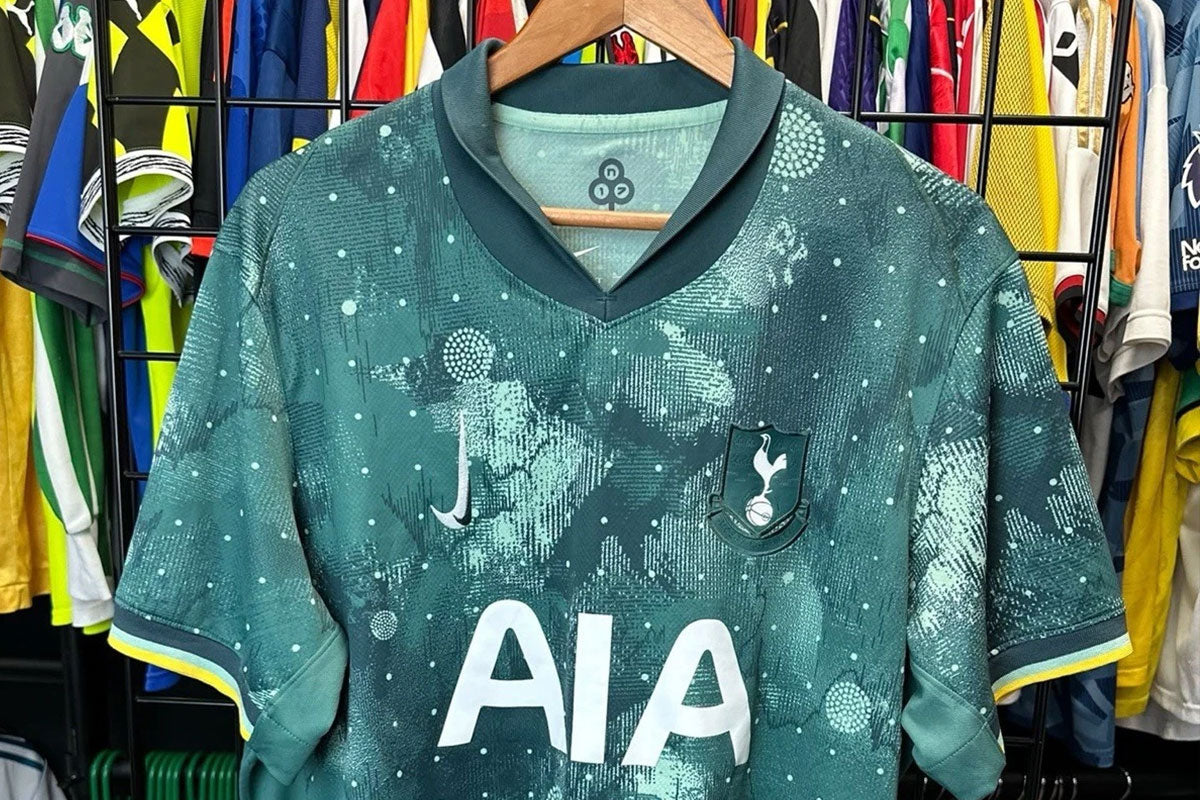
Puma's final kit before Under Armour took over in 2012, released in 2011-12, is widely regarded by collectors as the best of their spell at the club, a retro-influenced design that closed out the era well. Nike have supplied Tottenham since 2017, through a period that has included a Champions League final appearance in 2019, and the current AIA partnership, running since 2014, is now one of the longer-standing sponsor relationships in the Premier League. The 2021/22 home shirt brought the story full circle, working a subtly distorted version of the cockerel into its side panels to mark a hundred years since the emblem first appeared on the shirt in 1921.
Collecting Tottenham Shirts
Tottenham's kit history gives collectors an unusually wide spread of genuine grails: the understated 1960-61 Double shirt, the sponsorless 1981 centenary kit, the pinstriped Hummel designs of the late 80s and early 90s, and oddities like the one-match 1982/83 yellow third and the 2007/08 Puma polo. Third and away kits have often carried the club's boldest experiments, from camouflage-style patterns to unusual colourways rarely seen on the home shirt, and those alternate designs tend to be produced in far smaller numbers than the main kit, making a genuine example harder to track down years later. As with any vintage shirt, dating a genuine piece means checking the maker's construction, the crest version and the sponsor together, since Tottenham's badge alone has changed multiple times across the decades.
For the wider principles of spotting a genuine shirt, our guide on how to spot a fake Premier League shirt before you buy covers checks that apply just as well to vintage Spurs kits.
Owning One
Genuine vintage and current Tottenham shirts surface through specialist sellers and the retro football shirts collection, though the rarest pieces, like the centenary and one-match kits, are a genuine hunt.
The other route is to let one find you. An MJK mystery box sends one genuine football shirt without you knowing which one is coming, any club, any nation, any era, drawn from a supply network spanning more than 50 leagues and 53 countries.
As seen on BBC Dragons' Den. Co-founder Alex Street pitched Mystery Jersey King on Series 22, and Sara Davies MBE invested £50,000 for 15%. Read the full story here.
Related reads
Frequently Asked Questions
How long has the cockerel been on the Tottenham shirt?
The cockerel standing on a ball has appeared on Tottenham Hotspur's shirt continuously since 1921, paired with the club's Latin motto Audere est Facere, meaning to dare is to do. The exact design of the crest has changed several times since, but the cockerel itself has never left the shirt.
Why were Tottenham's cashmere shirts called lucky?
In 1930, Tottenham introduced off-white cashmere shirts that the team began changing into at half-time during matches. The habit became associated with a change in the team's fortunes, and the Daily Express newspaper began referring to them as the side's lucky shirts.
What was special about Tottenham's 1981 centenary shirt?
Tottenham's 1981 Le Coq Sportif centenary shirt was released without a sponsor's name on the front to mark the club's hundredth anniversary. Ricky Villa scored his famous winning goal in that season's FA Cup final replay against Manchester City wearing it, making it one of the most historically significant shirts in the club's history.
Did Tottenham win the 1991 FA Cup in a Hummel shirt?
No. Although Hummel supplied Tottenham's kits for most of that season, the club wore a brand-new Umbro shirt with longer shorts for the final itself against Nottingham Forest, in what turned out to be Hummel's last season as kit supplier. The Hummel shirts worn earlier in that campaign remain popular with collectors regardless.
What was the yellow shirt worn only once?
Tottenham's 1982/83 yellow third shirt, part of the club's centenary kit range, was worn in a single friendly away at Bristol Rovers in April 1983, a fixture chosen because it also marked Bristol Rovers' own centenary that year. It was never worn in any other match, making genuine examples extremely rare.
Who is Tottenham's current kit manufacturer and shirt sponsor?
Tottenham Hotspur have been supplied by Nike since 2017, and AIA has been the club's front-of-shirt sponsor since 2014, one of the longer-standing sponsorship relationships in the Premier League.
How does a mystery football shirt box work?
You pick your size, and Mystery Jersey King picks the shirt. One genuine football shirt arrives without you knowing which one is coming: any club, any nation, any era, drawn from a supply network spanning more than 50 leagues and 53 countries. MJK has shipped over 100,000 orders and is rated highly across more than 1,000 reviews.
Mystery Jersey King
Dare To Find Out What's Inside.
Every genuine shirt has a story like this one waiting behind it. Every MJK box puts one genuine football shirt through your door without you knowing which one is coming: any club, any nation, any era.
100,000+ orders shipped. Rated 4.7/5 from 1,000+ reviews. Shipping to 53 countries. As seen on BBC Dragons' Den.


Leave a comment
This site is protected by hCaptcha and the hCaptcha Privacy Policy and Terms of Service apply.