The Short Version
Liverpool did not always play in all red, and the shirt has carried some of the most loved sponsors in English football. From Shankly's decision to go head-to-toe red, through the Candy and Carlsberg years to the return of Adidas, this is the Liverpool shirt told era by era: the makers, the sponsors, and the specific shirts collectors chase hardest.
In this article
- Why Liverpool play in all red
- The kit makers, era by era
- The sponsors that defined the shirt
- The Candy years and the old-era classics
- Carlsberg, Istanbul and the golden run
- Standard Chartered and the modern era
- What collectors chase, and what to check
- Owning a piece of Liverpool history
- Frequently asked questions
Liverpool are one of the most collected clubs in world football, and the shirt is a huge part of why. Twenty league titles, six European Cups, and a red that is recognisable anywhere on earth. But like every great club, the Liverpool shirt is not one fixed thing. It is decades of change, each era tied to a manufacturer, a sponsor and a moment. This is that story, told the way a collector reads it.
Why Liverpool Play in All Red
It is easy to assume Liverpool have always worn red, but they have not. The club was founded in 1892, and their earliest home shirts were blue and white quarters, a world away from the modern identity. Red became the home colour, but for decades it was red shirts with white shorts, the conventional look of the era.
The change that created the modern Liverpool came in 1964, when Bill Shankly switched the team to all red, red shirts, red shorts and red socks together, believing the solid block of colour would make his players look bigger and more intimidating. It worked, both as psychology and as branding. That all-red identity is now inseparable from the club, and it is the foundation every Liverpool shirt since has been built on.

The Kit Makers, Era by Era
Knowing the maker is the fastest way to date a Liverpool shirt, and the sequence runs through some of the biggest names in sportswear. Umbro dressed the club through the great Bob Paisley years into the mid-1980s. Adidas took over in 1985 for a celebrated decade. Reebok arrived in 1996 and stayed to 2006, the era of Istanbul. Adidas returned for a second spell, then the American-owned Warrior Sports took the deal in 2012, handing to its parent New Balance in 2015. Nike took over in 2020 for the first title in thirty years, and in 2025 Adidas returned once again.
That is an unusually busy manufacturer history compared with a club like United, and it makes the maker's logo an especially useful checkpoint. The badge tells you it is Liverpool. The maker's mark, paired with the sponsor, pins down the era with real precision.
The Sponsors That Defined the Shirt
Liverpool hold a genuine place in football history here: they were the first English club to wear a front-of-shirt sponsor, when Hitachi appeared on the shirt in 1979. Before that the shirt carried only the Liver Bird and the maker's logo. That single decision helped open the door to the entire modern football sponsorship economy.
What followed is a run of sponsors that fans remember as fondly as the shirts themselves: Hitachi, then Crown Paints through the trophy-laden 1980s, then Candy, then the long Carlsberg era, and finally Standard Chartered. For Liverpool more than most clubs, the sponsor is a shorthand for a period of the club's story, which is exactly why collectors organise their shelves around it.
The Candy Years and the Old-Era Classics
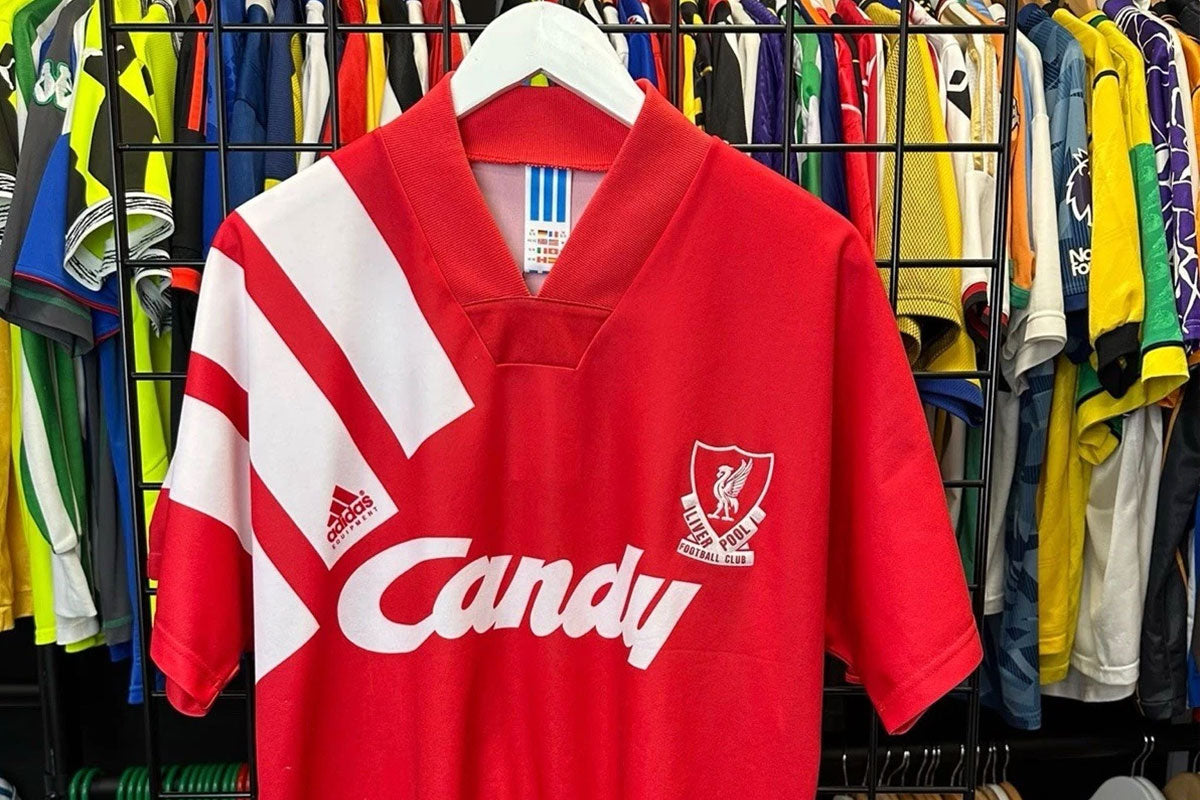
The Candy home shirt, made by Adidas and worn from the late 1980s into the early 1990s, is one of the most loved retro Liverpool shirts there is. Candy was an Italian appliance company, and the looping white logo against the red, often paired with subtle geometric detailing in the fabric, has become an icon of the period.
Its significance runs deeper than the design. This was the shirt Liverpool wore to win the old First Division title, the last championship of the pre-Premier-League era for the club, before a long wait for the next one. A shirt attached to the end of a golden age carries a weight that later, more successful shirts sometimes lack, and collectors feel it. We touch on the club's early-Premier-League shirts in the most iconic Premier League shirts from 1992 to today.

Carlsberg, Istanbul and the Golden Run
If one sponsor is synonymous with Liverpool, it is Carlsberg. The Danish brewer appeared on the shirt in 1992, the year the Premier League launched, and stayed for around eighteen years, the longest shirt sponsorship in English top-flight history. That span covers an enormous stretch of the club's modern story, across the Adidas and Reebok manufacturing eras.
The defining Carlsberg shirt for most collectors is the Reebok home of the mid-2000s, worn on the night in Istanbul in 2005 when Liverpool came back from three goals down to win the Champions League on penalties. It is one of the most collectable modern Liverpool shirts precisely because of the moment welded to it. Liverpool's away and third shirts of the Carlsberg years also produced cult favourites, including striking yellow and silver change designs. The wider story of why this era's design still resonates is in why the 90s produced the best football shirts ever made.
Standard Chartered and the Modern Era
Standard Chartered took over as sponsor in 2010 and has now become one of the longest partnerships in the club's history. It is the sponsor on the shirt for the two moments modern Liverpool fans treasure most: the 2019 Champions League triumph in Madrid, and the 2019/20 season when Liverpool won the Premier League, their first league title in thirty years.
Those title-winning and European shirts, made by New Balance, are already sought after and will only become more so with time, following the same path the Candy and Carlsberg classics took before them. Nike then took over as maker in 2020, and Adidas returned in 2025, bringing the club's shirt story full circle to a manufacturer that dressed it during its greatest decades.

What Collectors Chase, and What to Check
The most sought-after Liverpool shirts tend to be the ones tied to the biggest moments: the Candy title shirt, the Istanbul 2005 Reebok home, and the 2019/20 title-winning New Balance shirt. But the whole archive is collectable, and because Liverpool shirts were made in huge numbers, it is the genuinely scarce items, the older aways, the one-season oddities, that are hardest to find in good condition.
Because Liverpool are so heavily collected, they are also heavily faked. The maker-and-sponsor combination is your first authenticity checkpoint, since the two run on separate timelines and a fake often gets the pairing wrong, putting a sponsor on a shirt from the wrong manufacturer era. Beyond that, check the badge and manufacturer logo for stitching quality, the neck and wash labels, and the fabric against what the shirt should be for its period. Our full method is in how to tell if a retro football shirt is authentic. For another club history told the same way, see our Manchester United shirts collector's history.
With Liverpool, the sponsor is a decade in a word. Hitachi is the early Paisley years, Candy is the last of the old titles, Carlsberg is Istanbul. Learn them and you can date almost any Reds shirt on sight.
- Jamie King, co-founder, Mystery Jersey King
Owning a Piece of Liverpool History
Genuine retro Liverpool shirts surface regularly, and the retro football shirts collection is where to look. Liverpool are one of the most requested clubs there is, so the classics move quickly, and condition and authenticity are everything.
The other route is to let the shirt find you. An MJK mystery box sends one genuine football shirt without you knowing which one is coming: any club, any nation, any era, drawn from a supply network that spans more than 50 leagues and 53 countries. Liverpool shirts appear in the mix regularly, and if you would rather include or avoid particular clubs, you can tell us at checkout.
As seen on BBC Dragons' Den. Co-founder Alex Street pitched Mystery Jersey King solo on Series 22, and Sara Davies MBE invested £50,000 for 15%. Read the full story here.
Related reads
Frequently Asked Questions
Why do Liverpool play in all red?
Liverpool switched to an all-red kit in 1964 under manager Bill Shankly, who believed that red shirts, shorts and socks together would make his players look bigger and more intimidating. Before that the club wore red shirts with white shorts, and their earliest home shirts, back in the 1890s, were actually blue and white quarters.
What is the most iconic Liverpool shirt?
Two shirts dominate the conversation. The Adidas Candy home of the late 1980s and early 1990s is beloved as the last shirt Liverpool won an old First Division title in. The Reebok Carlsberg home worn on the night of the 2005 Champions League final in Istanbul is the other, prized for the comeback welded to it.
Were Liverpool the first English club with a shirt sponsor?
Yes. Liverpool became the first English club to wear a front-of-shirt sponsor when Hitachi appeared on the shirt in 1979. Before that the shirt carried only the Liver Bird crest and the manufacturer's logo. The decision helped open the door to the modern football shirt sponsorship economy.
How long did Carlsberg sponsor Liverpool?
Carlsberg appeared on the Liverpool shirt from 1992, the year the Premier League launched, and stayed for around eighteen years, the longest shirt sponsorship in English top-flight history. It is the sponsor on the shirt from the 2005 Champions League triumph in Istanbul, which makes those shirts especially collectable.
Who has made Liverpool's kits over the years?
Umbro dressed Liverpool from the 1970s to the mid-1980s, followed by Adidas, then Reebok from 1996 to 2006, then Adidas again, then Warrior Sports from 2012, New Balance from 2015, and Nike from 2020. In 2025 Adidas returned as manufacturer, a brand that dressed the club during several of its most successful periods.
Are Liverpool shirts often faked?
Yes. Because Liverpool are among the most collected clubs in the world, they are also among the most counterfeited. The maker and sponsor pairing is a useful first check, since a fake often gets the combination wrong by placing a sponsor on a shirt from the wrong manufacturer era, followed by close inspection of the badge stitching, the neck and wash labels, and the fabric for the period.
How does a mystery football shirt box work?
You pick your size, and Mystery Jersey King picks the shirt. One genuine football shirt arrives without you knowing which one is coming: any club, any nation, any era, drawn from a supply network spanning more than 50 leagues and 53 countries. MJK has shipped over 100,000 orders and is rated 4.7 out of 5 from more than 1,000 reviews.
Mystery Jersey King
Your Next Anfield Classic, Unopened.
The best shirts in any collection are the ones you did not go looking for. Every MJK box puts one genuine football shirt through your door without you knowing which one is coming: any club, any nation, any era.
100,000+ orders shipped. Rated 4.7/5 from 1,000+ reviews. Shipping to 53 countries. As seen on BBC Dragons' Den.


Leave a comment
This site is protected by hCaptcha and the hCaptcha Privacy Policy and Terms of Service apply.