
The Short Version
A claret body and blue sleeves have identified Aston Villa for nearly a century and a half, changed only rarely and always deliberately. Here is the story of Aston Villa's shirts, from the 1982 European Cup final to a kit with the Villa Park crowd's own chant stitched invisibly into the fabric.
In this article
Some clubs reinvent their shirt every few seasons. Aston Villa spent ninety years barely touching theirs. That consistency makes the moments the shirt did change, and the single night it mattered most, stand out with unusual clarity. Here is the story of Aston Villa's shirts, and the specific seasons that turned claret and blue into genuine collecting history.
Claret and Blue, Almost Unchanged
Founded in 1874, Aston Villa has worn some version of the same identity for almost its entire history: a claret body, blue sleeves, white shorts and sky blue socks. For roughly the first ninety years of the club's existence, that template barely moved, a level of consistency few English clubs can match. It was only once sponsorship and manufacturer branding entered the picture in the early 1980s that the design genuinely began to evolve season by season, and even then, the underlying claret and blue combination has never seriously been abandoned, only reinterpreted.
That long stability is exactly why Villa's kit history rewards close attention rather than a quick glance. Where some clubs have redesigned their identity from the ground up more than once, Villa's story is almost entirely about small, deliberate departures from a single, deeply consistent template, which makes each genuine change far easier to date and far more meaningful when it happens.

Rotterdam, 1982, and the Sixth English Winner
Aston Villa's single greatest night in European football came in Rotterdam in 1982, when Peter Withe's second-half goal beat Bayern Munich 1-0 in the European Cup final, under manager Tony Barton. It remains the club's only European Cup triumph, and it arrived wearing a claret shirt with blue pinstripes made by Le Coq Sportif, in what happened to be the French manufacturer's very first season supplying the club.
The scale of that achievement is easy to undersell decades later. Villa's win was the sixth consecutive year an English club had lifted the European Cup, a run of continental dominance that has never been repeated by any country before or since. That same year, 1982, also marked the arrival of Davenports Brewery as the club's first-ever shirt sponsor, meaning the shirt sponsorship era at Villa Park began in the exact same season as the club's finest hour, a coincidence that has never quite lost its significance for supporters who lived through it.
Villa have never won the European Cup again since that night in Rotterdam, which only adds to the shirt's weight as a collector's piece. Unlike a club with several continental titles to their name, spread across different kits and different eras, every genuine claim Villa can make to being champions of Europe belongs to that single claret and blue pinstriped shirt.
Hummel Breaks the Mould
After roughly ninety years of minimal change, Villa's late-1980s Hummel shirts marked a genuine departure. The 1987/88 and 1988/89 design abandoned the traditional claret-body, blue-sleeve layout entirely in favour of a half-and-half segmented style across both the shirt and sleeves, finished with Hummel's distinctive shoulder arrows. It remains one of the more unusual entries in the club's kit history precisely because it broke a template that had barely moved since the nineteenth century, and it stands as proof that even a club this attached to tradition was willing to experiment when a manufacturer brought a genuinely different idea to the table.
Villa changed the shirt so rarely that when they finally did, in Rotterdam and again with Hummel, it actually meant something. Consistency is what makes the genuine departures collectable.
- Jamie King, co-founder, Mystery Jersey King
Asics, Muller and a Coca-Cola Cup
The mid-1990s brought Villa's only-ever kit made by Asics, worn between 1993 and 1995 and paired with sponsorship from the yoghurt brand Muller, one of the most talked-about sponsor eras in the club's history precisely because it split opinion so sharply among supporters at the time. Whatever fans made of it, the shirt has aged into a genuine cult classic, helped considerably by what the team achieved while wearing it: Aston Villa won the League Cup, sponsored that year as the Coca-Cola Cup, in 1994, giving the era a trophy to anchor the shirt's place in collecting history. Asics never supplied the club again after this spell ended, which only adds to the shirt's status as a genuinely one-off entry in Villa's manufacturer history rather than part of a longer relationship.

The Two-Company Kit Deal
Not every chapter of Villa's kit history has been about design. When the club's partnership with Under Armour broke down, ending after just two years of what had originally been signed as a five-year deal, the club took an unusual approach to replacing it. Birmingham-based fashion house Luke 1977, led by Creative Director and lifelong Villa supporter Luke Roper, took on product design, while American sports manufacturer Fanatics handled production and ran the Villa Park club store. Splitting design and manufacturing between two separate companies in this way is a genuinely uncommon arrangement in English football kit deals.
Villa's more recent switch to Kappa in 2019/20 came at a fitting moment of its own, arriving in the same season the club returned to the Premier League after three seasons in the Championship, giving the new manufacturer relationship a genuine promotion story to build around from the very start.
The Chant Stitched Into the Shirt
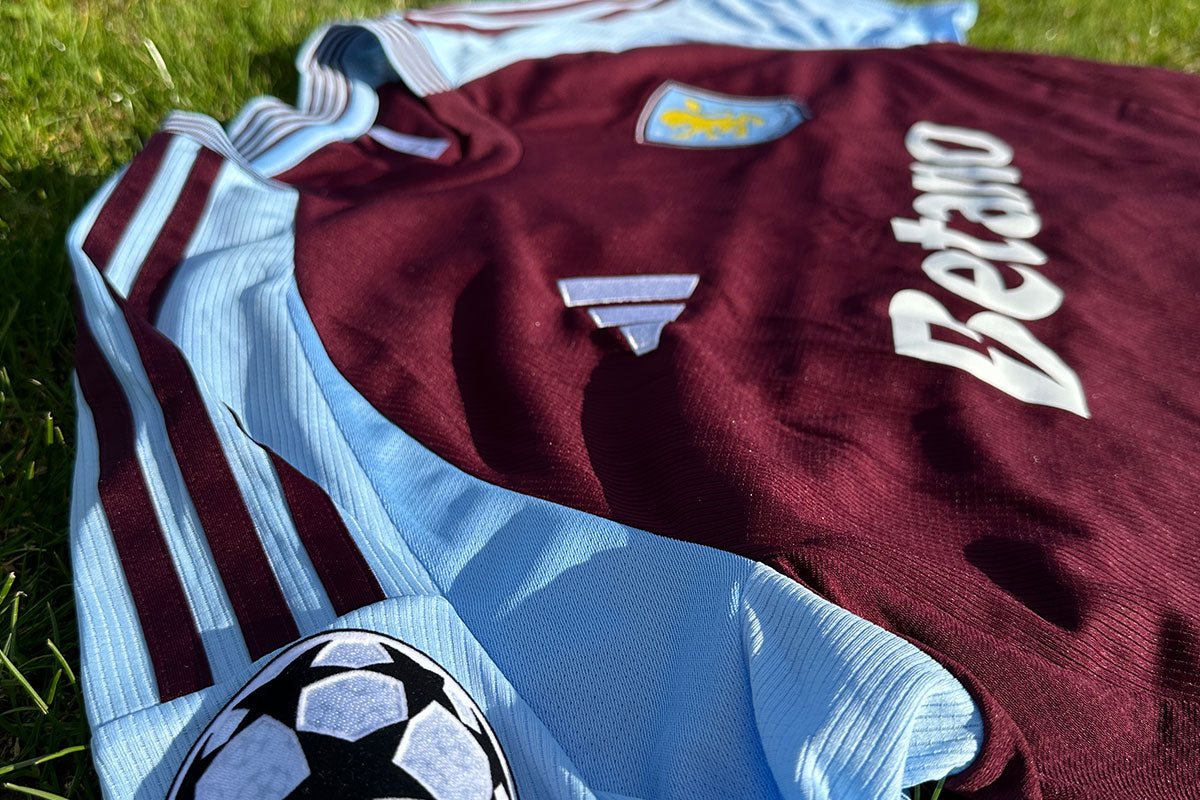
Few tribute kits anywhere in football carry a detail as specific as Villa's fortieth-anniversary nod to 1982. The 2021/22 Kappa away kit paid direct homage to the European Cup final shirt itself, finished in white with vertical claret pinstripes exactly mirroring what Withe and his teammates wore in Rotterdam, with a claret band on the reverse inscribed 1981-1982.
That same season's home shirt went further still, working a subtle background print into the fabric made from the actual soundwaves of the Villa Park crowd singing Allez, Allez, Allez, rendering a piece of matchday atmosphere as a pattern most people would never notice unless they knew to look for it. Every kit that season also carried a circular crest in place of the usual shield, a specific one-off change made purely to honour the 1982 European Cup-winning squad, before the club reverted to its familiar shield the following year.
Very few tribute kits go beyond a simple colour reference or an anniversary date printed somewhere on the shirt, and Villa's 2021/22 season did both of those things while also finding a genuinely inventive way to encode the sound of the ground itself into the design. It stands as one of the most thoughtfully researched anniversary kits produced anywhere in English football that season.
Collecting Aston Villa Shirts
Villa's kit history rewards collectors with an unusually wide spread of genuine pieces: the 1982 European Cup final shirt itself, the Hummel half-and-half design that broke ninety years of convention, the Asics and Muller era tied to the 1994 League Cup win, and the detailed 2021/22 tribute kits. As with any vintage shirt, checking the maker's construction, the exact sponsor and the season's crest together is the surest way to confirm a genuine piece rather than a later reissue.
For the wider principles of authenticating a shirt, our guide on how to spot a fake Premier League shirt before you buy covers checks that apply just as well to vintage Villa kits.
Owning One
Genuine vintage and current Aston Villa shirts surface through specialist sellers and the retro football shirts collection, though the rarest pieces, particularly anything from the 1982 final itself, are a genuine hunt.
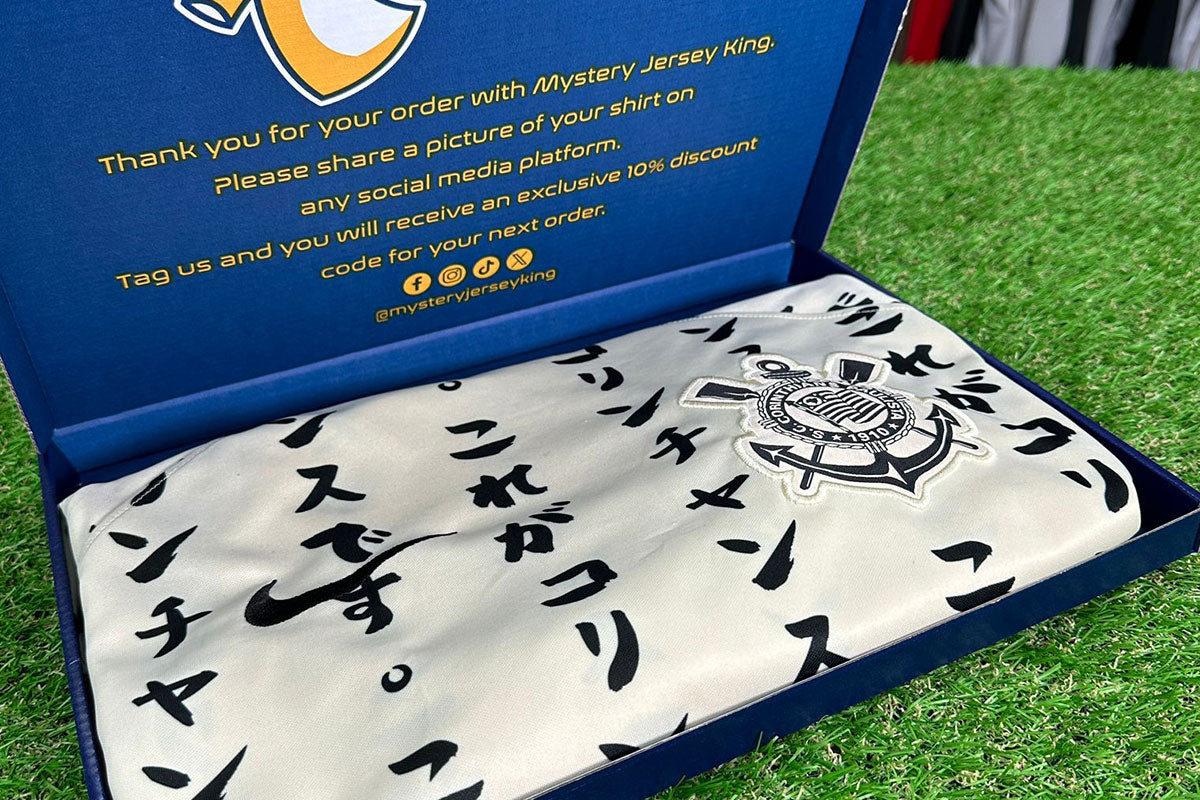
The other route is to let one find you. An MJK mystery box sends one genuine football shirt without you knowing which one is coming, any club, any nation, any era, drawn from a supply network spanning more than 50 leagues and 53 countries.
As seen on BBC Dragons' Den. Co-founder Alex Street pitched Mystery Jersey King on Series 22, and Sara Davies MBE invested £50,000 for 15%. Read the full story here.
Related reads
Frequently Asked Questions
What did Aston Villa wear when they won the 1982 European Cup?
Aston Villa wore a claret shirt with blue pinstripes, made by Le Coq Sportif in their first season supplying the club, when they beat Bayern Munich 1-0 in the 1982 European Cup final in Rotterdam, with Peter Withe scoring the winning goal.
Who was Aston Villa's first-ever shirt sponsor?
Davenports Brewery was Aston Villa's first-ever shirt sponsor, arriving in 1982, the same year the club won the European Cup, meaning the shirt sponsorship era at Villa Park began in the club's greatest season.
What was unusual about Aston Villa's late-1980s Hummel shirt?
Aston Villa's 1987/88 and 1988/89 Hummel shirt abandoned the club's traditional claret-body, blue-sleeve template in favour of a half-and-half segmented striped design, finished with Hummel's signature shoulder arrows. It broke a look that had barely changed for roughly ninety years.
What trophy did Aston Villa win in their Asics and Muller-sponsored shirt?
Aston Villa won the League Cup, sponsored that season as the Coca-Cola Cup, in 1994, while wearing their Asics-made shirt sponsored by the yoghurt brand Muller, one of the most talked-about kits in the club's history.
What detail was hidden in Aston Villa's 2021/22 home shirt?
Aston Villa's 2021/22 home shirt featured a subtle background print made from the soundwaves of the Villa Park crowd's Allez, Allez, Allez chant, worked directly into the fabric pattern. The same season's away kit paid tribute to the 40th anniversary of the 1982 European Cup final shirt.
Who makes Aston Villa's current shirts?
Kappa became Aston Villa's kit manufacturer in 2019/20, the same season the club returned to the Premier League after three seasons in the Championship. Before Kappa, the club had an unusual two-company arrangement, with Luke 1977 handling product design and Fanatics managing manufacturing and retail.
How does a mystery football shirt box work?
You pick your size, and Mystery Jersey King picks the shirt. One genuine football shirt arrives without you knowing which one is coming: any club, any nation, any era, drawn from a supply network spanning more than 50 leagues and 53 countries. MJK has shipped over 100,000 orders and is rated highly across more than 1,000 reviews.
Mystery Jersey King
A Piece Of History, Waiting Inside.
Every genuine shirt has a story like this one behind it. Every MJK box puts one through your door without you knowing which one is coming: any club, any nation, any era.
100,000+ orders shipped. Rated 4.7/5 from 1,000+ reviews. Shipping to 53 countries. As seen on BBC Dragons' Den.


Leave a comment
This site is protected by hCaptcha and the hCaptcha Privacy Policy and Terms of Service apply.