

The short version
A shirt does not become retro by getting old. It becomes retro when it is unmistakably of a moment that has passed, and when enough people who were watching want that moment back. By that test, 2026 produced an unusual number of candidates: the last Adidas Germany kit, Brazil's first Jordan shirt, the returning Trefoil aways, and a champion's red that will be reissued for decades.
In this article
Every retro shirt was once just this season's kit, hanging on a rail, entirely unremarkable. The interesting question is not which 2026 shirts are good, which we have already argued about at length, but which of them will still feel special in 2046, when a generation who watched this tournament as children are old enough to want a piece of it back. That is a different question, and it has a surprisingly consistent answer.
How a Shirt Actually Becomes Retro
Three things have to happen, and they happen in order.
First, the shirt has to be datable. A kit that could be from any year never becomes retro; it just becomes old. The shirts that acquire retro status carry something that fixes them to a moment: a logo that was only used briefly, a manufacturer partnership that ended, a design language that a decade later looks unmistakably of its time.
Second, the moment has to pass properly. There is usually a gap of roughly twenty years between a shirt being current and being desirable again. It has to stop being recent, spend a while being dated, and come out the other side. Almost every kit goes through an unfashionable middle period, and plenty get thrown away during it, which is exactly what creates the scarcity later.
Third, people have to want the memory. The audience for a retro shirt is largely people who were watching at the time, particularly people who were young at the time. That is why the nostalgia cycle tracks so closely to generational age, and why 2026 shirts will start to matter properly in the 2040s.
Design quality helps at every stage, but it is not the mechanism. The mechanism is time plus identifiability plus memory. Our guide to the best retro football shirts of all time is essentially a list of kits that cleared all three.

The Era Markers of 2026
On the first test, being datable, 2026 is exceptionally well equipped. Three developments will let anyone place these shirts at a glance decades from now.
The Adidas Trefoil returned to away kits, back at a World Cup for the first time in 36 years. A logo change is the single cleanest era marker in kit collecting, and this one stamps an entire generation of shirts with a date. Any Adidas away shirt from this cycle is instantly placeable.
Germany's home was the last kit Adidas will ever make for them, ending one of the longest partnerships in the sport. A shirt that closes an era carries built-in historical weight, and Germany's early exit does nothing to reduce it. If anything it sharpens the story.
Brazil's away was the first Brazil national team shirt to carry the Jordan Jumpman rather than the Nike Swoosh. A first is as datable as a last, and this one reaches beyond football into sneaker and streetwear collecting, two markets with long memories and deep pockets.
Add the format itself. 2026 was the first 48-nation World Cup, producing more than 96 kits. Every shirt from this tournament is part of the first cohort of a new era, which is the kind of detail that gets remembered.
The Champion's Shirt, Which Is Guaranteed
Spain's red home requires the least speculation of anything here. Winning shirts become retro classics without exception, because they are reissued, photographed and referenced continuously for decades. It is a deep red Adidas design with thin yellow pinstripes drawn from the flag and crest, navy sleeves, and Three Stripes in red-yellow-red, and it was worn to a 1-0 win over Argentina after extra time in the final at MetLife, Ferran Torres settling it, with Spain conceding one goal in the entire tournament.
The precedent is Spain's own 2010 kit, which is now firmly a retro classic and was, at the time, simply the current shirt. The 2026 red will follow the same path on a longer timescale, with an extra historical footnote attached: winning it made Spain the first nation to hold the men's and women's World Cups at the same time.
The Designs Built to Survive
Beyond the guaranteed and the datable, some shirts have design language that will read as distinctly 2026 in the way that certain patterns now read as unmistakably 1994.
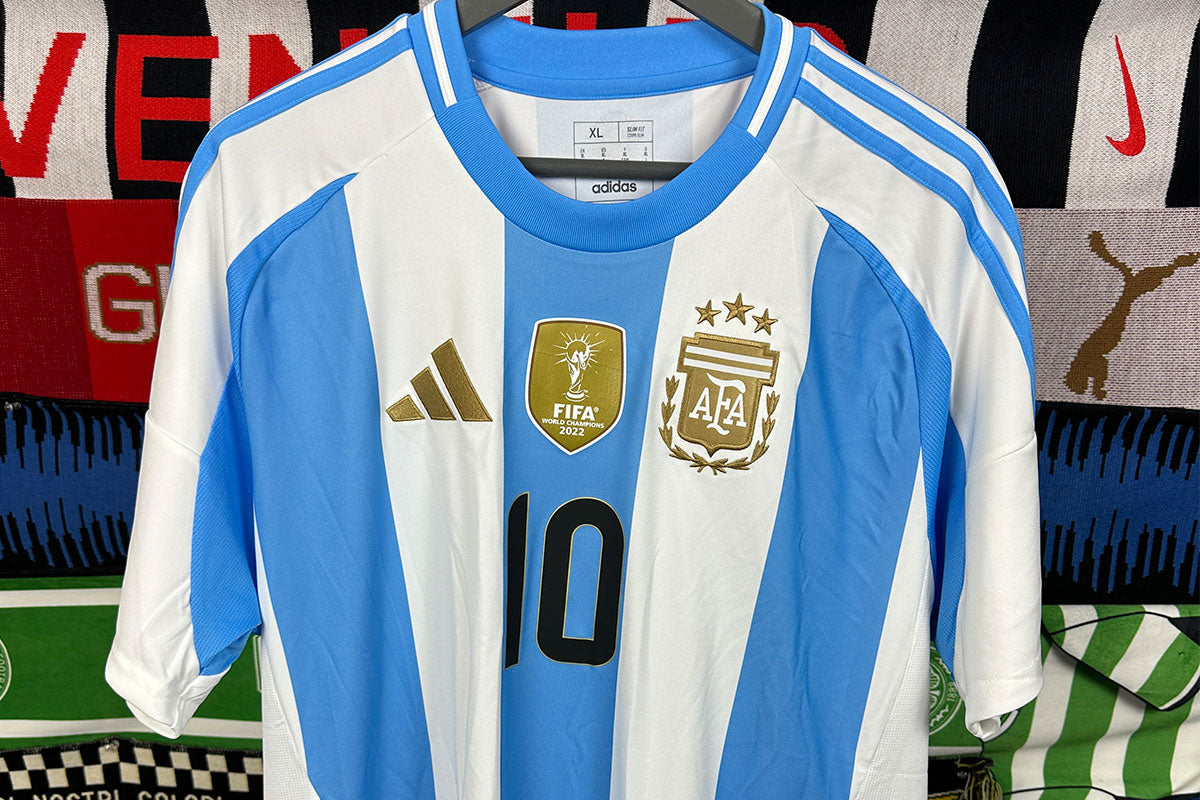
Argentina's three-tone gradient home. The best-rated design of the tournament, with the sky-blue and white stripes rendered as a gradient referencing the 1978, 1986 and 2022 winning sides. Messi wore it while scoring eight goals and breaking the all-time World Cup scoring record in what is almost certainly his last World Cup. Datable, beautiful, and attached to an ending. It has everything except the trophy.
South Korea's hidden tiger. A white tiger woven into the fabric in tonal camouflage, visible only up close. Technically ambitious in a way that will look very much of this decade in twenty years, which is precisely what makes a shirt retro rather than merely old.
France's Statue of Liberty away. A glacier-green kit honouring the monument France gave the host nation. Conceptual away shirts tied to a specific host country cannot be repeated, which fixes them permanently to one tournament.
Our full ranking of the field is in the 2026 World Cup kit tier list.

The Sleepers Nobody Is Talking About
The most reliable retro classics are rarely the famous shirts, because famous shirts were produced in enormous quantities and everybody kept theirs. Scarcity is what turns an ordinary kit into a hunt.
Debut nations. 2026's expanded format brought nations to a World Cup for the first time, and their shirts were produced in tiny runs sized for a single appearance. In twenty years these will be genuinely difficult to find, while Spain and Argentina shirts remain plentiful. Scarcity plus a genuine historical first is the classic recipe.
Away shirts generally. Made in smaller numbers, worn less, and usually where the braver design work happened. Almost every era's most collectable kits are aways, for exactly these reasons.
Goalkeeper shirts. This is the one most people will overlook. 2026 was the first World Cup where goalkeepers received bespoke national designs rather than a generic template. First-of-a-kind, produced in the smallest quantities of any category, and historically undervalued. If any group of 2026 shirts is being systematically underrated right now, it is this one.
The Shirts That Will Not Age Well
Worth being honest about the other side. The kits least likely to become retro classics are the anonymous ones: template-based designs with a badge applied, in colours that could belong to any year. They are not bad shirts. They are simply not identifiable, and identifiability is the first test.
The same applies, less obviously, to some very good-looking shirts. A well-executed but conventional kit from a nation that went out early has design quality but no era markers and no moment. It will be remembered fondly by that nation's supporters and by almost nobody else, which is a perfectly respectable fate but not a retro classic.
The retro shirts people hunt hardest for are the ones nobody thought worth keeping at the time. That is the whole mechanism. Scarcity is created by indifference, twenty years earlier.
- Jamie King, co-founder, Mystery Jersey King
Keeping a Shirt Worth Keeping
If any of this persuades you to hold onto a 2026 shirt for twenty years, condition is what will determine whether it was worth doing. The gap in value between a well-kept shirt and a faded, misshapen one is enormous, and most of the damage is done by ordinary domestic laundry rather than by wear.
The essentials: wash cool and inside out, never tumble dry, keep it out of direct sunlight, and store it folded flat or on a padded hanger rather than a wire one that will distort the shoulders. If the shirt is unworn, keep the tags and packaging. We have covered the detail in how to wash a football shirt, and the wider practice of building a collection properly in 15 tips to cultivate your football shirt collection.
Starting With the Classics
The most useful thing you can do to understand which 2026 shirts will age well is to handle the ones that already did. The retro football shirts collection is where the previous eras surface, and if you are buying vintage second-hand anywhere, how to tell if a retro football shirt is authentic is worth reading first, because the fakes in that market are considerably better than the ones aimed at current kits.
The other approach is to let the shirt arrive without choosing it. An MJK mystery box sends one genuine football shirt without you knowing which one is coming: any club, any nation, any era, drawn from a supply network spanning more than 50 leagues and 53 countries. Given that the whole argument of this post is that nobody correctly predicts which shirts matter, there is a certain logic to it.

As seen on BBC Dragons' Den. Co-founder Alex Street pitched Mystery Jersey King solo on Series 22, and Sara Davies MBE invested £50,000 for 15%. Read the full story here.
Related reads
Frequently Asked Questions
What makes a football shirt become a retro classic?
Three things, in order. The shirt must be datable, carrying something that fixes it to a specific moment such as a logo change or an ended partnership. Enough time must pass, typically around twenty years, including an unfashionable middle period during which many are thrown away. And people who watched at the time must want the memory back.
Which 2026 World Cup shirts will become retro classics?
Spain's winning red home is effectively guaranteed, as winning shirts always are. Germany's home, the last Adidas will ever make for them, and Brazil's away, the first Brazil kit with the Jordan Jumpman, are strong era markers. Argentina's gradient home, South Korea's hidden tiger and France's Statue of Liberty away all have the design language to age into icons.
Why are 2026 away shirts significant for collectors?
Adidas returned the Trefoil logo to its national team away kits for 2026, bringing it back to a World Cup for the first time in 36 years. A logo change is the cleanest era marker in kit collecting, so the whole generation of 2026 aways is instantly datable. Away shirts are also produced in smaller numbers than home kits and usually carry the braver design work.
Are goalkeeper shirts worth collecting?
They are arguably the most underrated category from 2026. It was the first World Cup at which goalkeepers received bespoke, nation-specific designs rather than a generic template, making them first-of-a-kind. They are also produced in the smallest quantities of any category and have historically been overlooked, which is the combination that creates scarcity later.
Which shirts will not become retro classics?
Anonymous template-based designs in colours that could belong to any year, because identifiability is the first requirement. The same applies to well-made but conventional kits from nations that went out early: they have design quality but no era markers and no defining moment, so they are remembered fondly by their own supporters and by few others.
How should I store a shirt I want to keep for decades?
Wash cool and inside out, never tumble dry, and keep the shirt out of direct sunlight. Store it folded flat or on a padded hanger rather than a wire one, which distorts the shoulders over time. If the shirt is unworn, retain the tags and original packaging. The value gap between a well-kept shirt and a faded one is substantial.
How does a mystery football shirt box work?
You pick your size, and Mystery Jersey King picks the shirt. One genuine football shirt arrives without you knowing which one is coming: any club, any nation, any era, drawn from a supply network spanning more than 50 leagues and 53 countries. MJK has shipped over 100,000 orders and is rated 4.7 out of 5 from more than 1,000 reviews.
Mystery Jersey King
Today's Kit Is Tomorrow's Retro Classic.
Nobody kept the shirts that are worth the most now. Every MJK box puts one genuine football shirt through your door without you knowing which one is coming: any club, any nation, any era.
100,000+ orders shipped. Rated 4.7/5 from 1,000+ reviews. Shipping to 53 countries. As seen on BBC Dragons' Den.



Leave a comment
This site is protected by hCaptcha and the hCaptcha Privacy Policy and Terms of Service apply.