The Short Version
One of England's oldest and proudest clubs, Everton have worn royal blue with distinction for well over a century. From the NEC shirts of the great mid-80s side to the Umbro classics collectors love, this is the Everton shirt told era by era: the makers, the sponsors, and the shirts the Toffees faithful chase hardest.
In this article
- Royal blue and the Toffees
- The kit makers, era by era
- The NEC years and the mid-80s greats
- The away shirts, from white to amber
- The sponsors that dated the shirt
- The modern era and a new home
- A founding club of English football
- What collectors chase, and what to check
- Owning a piece of Everton history
- Frequently asked questions
Everton are one of the founding institutions of English football, a club with more top-flight seasons than almost any other and a heritage that stretches back to 1878. The royal blue shirt is among the most storied in the country, worn by title-winning sides and adored by one of football's most loyal supports. This is the Everton shirt, era by era, the way a collector reads it.
Royal Blue and the Toffees
Everton were founded in 1878, taking their name from the district of Liverpool where the club began, which makes them older than their great neighbours and one of the oldest clubs in English football. After some early experimentation, the club settled on royal blue, and that rich blue has been Everton ever since, as fixed a part of the club's identity as anything in the game.
The club is known as the Toffees, a nickname tied to the local sweet shops of the area, and it carries a sense of tradition and doing things properly that runs through the club's history and, for many supporters, through the dignity of the blue shirt itself.

The Kit Makers, Era by Era
The maker's mark is the quickest way to date an Everton shirt, and the club has a long and loyal relationship with one brand in particular. Umbro have made Everton's kits across four separate spells, from the 1970s through to 2000, again from 2004 to 2009, and again from 2014 to 2020. Le Coq Sportif dressed the club in the mid-80s and again around 2010, Puma had a spell at the turn of the millennium, Nike a brief period, and more recently Hummel and then Castore have taken the shirt into its current era.
Those handovers give clear visual eras to organise a collection around, but it is the Umbro shirts, especially from the late-80s and 90s, that sit at the heart of Everton collecting. Pair the maker with the sponsor and almost any Everton shirt can be placed within a season or two.
The NEC Years and the Mid-80s Greats
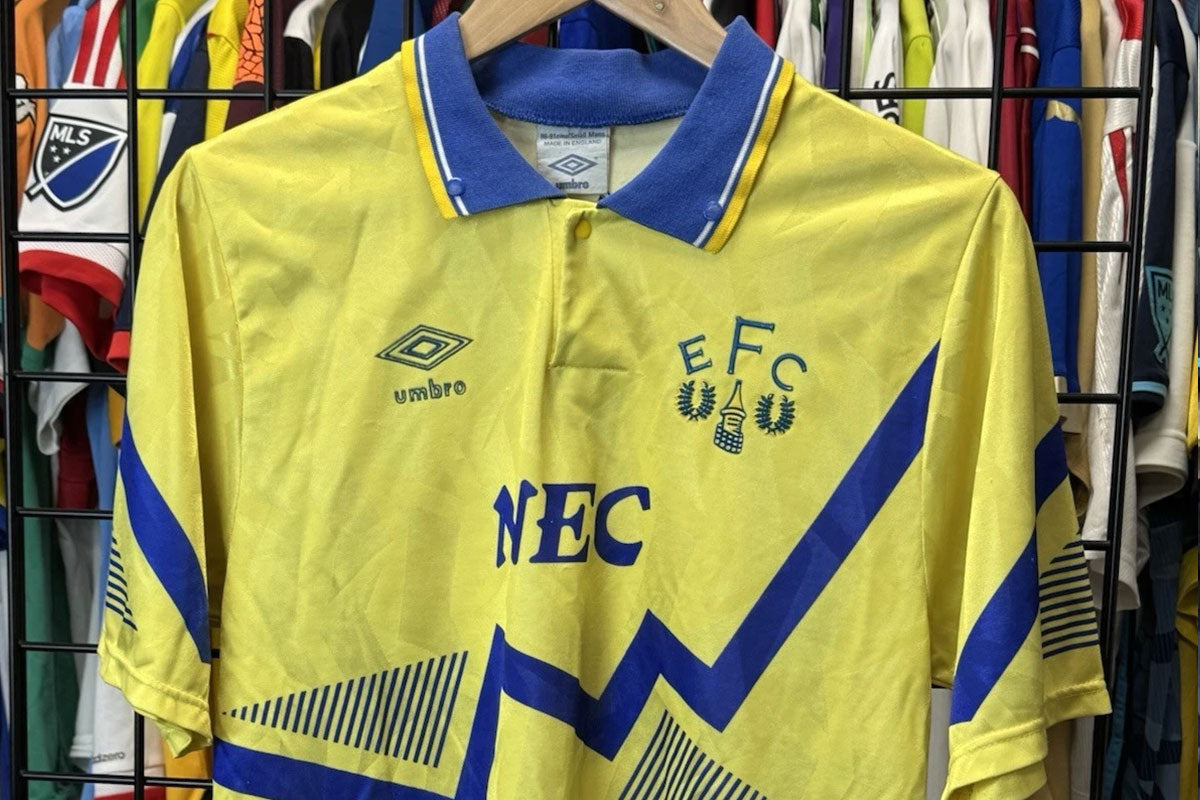
The most treasured period in Everton's modern shirt history belongs to the mid-1980s. This was the era of the club's greatest recent success, when Everton won the First Division title in 1985 and again in 1987, and were among the best sides in England. The shirts of that side, blue and finished with the NEC sponsor that arrived in 1985 and stayed for around nine seasons, are the ones Evertonians treasure most.
NEC, a Japanese electronics company, gave its name to a simple, clean text logo across the blue that has become inseparable from that golden period. For collectors, an NEC-era Everton shirt is not just a kit, it is a link to the last time the club stood at the very top of English football, which is exactly the kind of emotional weight that makes a shirt endure. The 1995 FA Cup-winning side, managed by Joe Royle, added another cherished chapter to the shirt's story.

The Away Shirts, from White to Amber
With the home shirt locked into its royal blue, Everton's away and third kits are where the design has always had more freedom. The traditional change colour was white, an elegant contrast to the blue, but over the decades the club has produced some of its most characterful shirts in other shades, particularly yellow and amber, which have become firm favourites among collectors.
The bright yellow away kits of the 90s, made by Umbro and carrying the NEC sponsor, are a perfect example, bold and cheerful where the home shirt is stately. More recent change kits have played with navy and salmon tones too, including a third shirt that referenced the club's first league title of 1890/91. As with most clubs, it is these away shirts, made in smaller numbers than the ever-present blue, that are often the harder items for a collector to track down.
The Sponsors That Dated the Shirt
Everton came to shirt sponsorship, like most clubs, at the end of the 1970s, and the sequence of sponsors since then maps neatly onto the eras of the shirt. After an early Hafnia deal came NEC, the sponsor of the glory years, followed by Danka, then One2One, then the Chinese electronics brand Kejian, and then the long Chang partnership that ran through much of the 2000s and 2010s.
One detail speaks volumes about the club's character. During the Chang beer sponsorship, Everton became the first Premier League club to remove the alcohol sponsor's branding from the replica shirts sold to children, choosing not to advertise alcohol to young fans. It is a small thing, but it fits a club whose whole identity leans on doing things the right way, and it is the kind of detail collectors appreciate knowing about the shirts they own.
The Modern Era and a New Home
Everton's more recent shirts, through the Hummel and Castore eras, have leaned into the club's rich heritage, with designs referencing past kits and the architecture of the club's long-time home. Hummel even marked the club's one hundredth birthday with a grey third shirt built around their own famous Denmark 1986 concept, and one home shirt carried the coordinates of Goodison Park printed inside the neck as Everton prepared to leave it.
As Everton move into a new stadium era, these shirts take on an added significance as among the last worn at a historic old ground, exactly the kind of context that makes a season's kit a future classic. For collectors, the modern Everton shirts are quietly gaining importance, marking a genuine moment of transition for one of England's oldest clubs.

What Collectors Chase, and What to Check
The most sought-after Everton shirts are the mid-80s title-era home kits and the NEC-sponsored shirts of the club's golden period, along with the bright yellow aways and the 1995 FA Cup-winning kit. Named and numbered examples tied to the club's heroes carry a particular premium. But the whole royal blue archive is collectable, and dating a shirt correctly by its maker and sponsor is part of the craft.
Everton are a well-collected club, so authenticity matters. The maker-and-sponsor pairing is your first checkpoint, since a fake often places a sponsor on a shirt from the wrong manufacturer era. Beyond that, check the badge and manufacturer logo for stitching quality, the neck and wash labels, and the fabric against what the shirt should be for its period.
An NEC-era Everton shirt is a link to the last time the Toffees ruled England. With a club this old and this proud, the shirt is never just a shirt: it is a piece of a story that runs back to 1878.
- Jamie King, co-founder, Mystery Jersey King
A Founding Club of English Football
Everton's place in the game runs deeper than most people realise. The club were founder members of the Football League in 1888, one of only a dozen clubs to play in its very first season, and they have spent more seasons in England's top division than almost any other club in the country's history. That unbroken presence at the top level is a huge part of why the shirt carries such weight.
It also means the shirt has been present at nearly every stage of English football's evolution, from the earliest days of organised league football through to the Premier League era. Few clubs can claim a shirt history with that kind of continuity, and it is one of the reasons Everton collecting rewards a long view: there is always another era, another sponsor, another design worth tracking down.
Owning a Piece of Everton History
Genuine retro Everton shirts surface regularly, and the retro football shirts collection is where to look. The NEC-era classics in particular move quickly, so condition and authenticity are everything.
The other route is to let the shirt find you. An MJK mystery box sends one genuine football shirt without you knowing which one is coming: any club, any nation, any era, drawn from a supply network that spans more than 50 leagues and 53 countries. Everton shirts appear in the mix regularly, and if you would rather include or avoid particular clubs, you can tell us at checkout.
As seen on BBC Dragons' Den. Co-founder Alex Street pitched Mystery Jersey King on Series 22, and Sara Davies MBE invested £50,000 for 15%. Read the full story here.
Related reads
Frequently Asked Questions
Why are Everton called the Toffees?
The nickname the Toffees comes from the sweet shops associated with the club's early home in the Everton district of Liverpool. It has stuck for well over a century and remains one of the most affectionate nicknames in English football, tied closely to the club's royal blue identity.
What is the most iconic Everton shirt?
The royal blue home shirts of the mid-1980s, made by Umbro and carrying the NEC sponsor, are the most treasured. They were worn as Everton won the First Division title in 1985 and 1987, the club's greatest modern era, which gives those shirts exceptional emotional weight for supporters.
Who has made Everton's kits over the years?
Umbro have made Everton's kits across four separate spells, most notably from the mid-1980s to 2000. Le Coq Sportif, Puma, Nike and Hummel have all had periods too, with Castore the maker in the current era. The Umbro shirts of the late 1980s and 1990s are at the heart of Everton collecting.
Which Everton sponsors help date a shirt?
Everton wore no sponsor until Hafnia at the end of the 1970s, followed by NEC through the glory years of 1985 to the mid-1990s, then Danka, One2One and Kejian, and then the long Chang partnership through the 2000s and 2010s. Pairing the sponsor with the kit maker quickly pins down a shirt's era.
Were Everton the first club to remove alcohol branding from kids' shirts?
Yes. During the Chang beer sponsorship, Everton became the first Premier League club to sell junior replica shirts without the alcohol brand's name, choosing not to advertise alcohol to children. It is a detail that fits the club's identity and one collectors often note about the shirts of that era.
Are Everton shirts often faked?
Everton are a well-collected club, so authenticity matters when buying older shirts. The maker-and-sponsor pairing is a useful first check, since fakes often place a sponsor on a shirt from the wrong manufacturer era, followed by close inspection of badge stitching, the neck and wash labels, and the fabric for the period.
How does a mystery football shirt box work?
You pick your size, and Mystery Jersey King picks the shirt. One genuine football shirt arrives without you knowing which one is coming: any club, any nation, any era, drawn from a supply network spanning more than 50 leagues and 53 countries. MJK has shipped over 100,000 orders and is rated highly across more than 1,000 reviews.
Mystery Jersey King
Your Next Toffees Classic, Unopened.
The best shirts in any collection are the ones you did not go looking for. Every MJK box puts one genuine football shirt through your door without you knowing which one is coming: any club, any nation, any era.
100,000+ orders shipped. Rated 4.7/5 from 1,000+ reviews. Shipping to 53 countries. As seen on BBC Dragons' Den.

Leave a comment
This site is protected by hCaptcha and the hCaptcha Privacy Policy and Terms of Service apply.