
In this article
- Why Brazil World Cup shirts occupy a different category
- 1958 - the shirt that started a dynasty
- 1962 - Garrincha's shirt, Chile
- 1970 - the most iconic football shirt ever made
- 1982 - the elegant tragedy of Tele Santana's side
- 1994 - Umbro's modern classic
- 1998 - Ronaldo, Nike, and the shirt that nearly won
- 2002 - the fifth star and the redemption
- 2026 - what Brazil are wearing in North America
- The greatest Brazil World Cup shirt ever made
- Getting a Brazil World Cup shirt in 2026
- Frequently asked questions
Brazil have won the World Cup five times. No other nation has won it more than four. The yellow shirt with green trim, blue shorts and white socks is, by some distance, the most recognisable kit in international football, and the most consistently photographed across nine decades of tournament play. From Pele in Sweden in 1958 to Ronaldo in Yokohama in 2002, the same essential design has carried the weight of more football history than any other shirt in the game.
This post ranks the best Brazil World Cup shirts ever made, tournament by tournament, with the specific moments and details that make each one stand apart. We also look at what Brazil are wearing in North America this summer, and which Brazil shirt is most likely to become the next great collector's piece.
Why Brazil World Cup Shirts Occupy a Different Category
Every major nation's World Cup shirts carry their own significance. Brazil's carry something else entirely. The yellow shirt is the only kit in football history that is recognisable from a distance of fifty metres on a black and white television, in a photograph cropped to a single sleeve, or as a silhouette on a pub wall. It has been worn by more individually great footballers across more tournaments than any other shirt in existence, which gives every iteration a baseline of cultural weight that no other national team kit can quite match.
The design has barely changed since 1970. That continuity is itself part of the appeal. Brazil's home shirts across the last fifty-five years are recognisably the same garment, with small evolutions in collar style, fabric and crest, but the same essential identity. That makes the best Brazil World Cup shirts a particularly interesting category to rank, because the differences between them are about context, players and moments rather than radical design departures.

1958 - the Shirt That Started a Dynasty
Brazil's first World Cup victory came in Sweden in 1958, in a shirt produced by Topper, the Brazilian sportswear brand that would clothe the Selecao for more than three decades. The design was straightforward: round neck, short sleeves, plain yellow with small green details on the collar and cuffs. There was nothing about the kit itself that suggested what would follow.
What followed was a 17-year-old Edson Arantes do Nascimento, known as Pele, scoring two goals in the final against Sweden at the Rasunda Stadium in Stockholm. Brazil won 5-2. The 1958 shirt is the founding document of the most successful international football team in history, which gives it a significance entirely independent of design quality. Original Topper examples from 1958 are extraordinarily rare and command prices that reflect their status as historical objects rather than garments.
1962 - Garrincha's Shirt, Chile
The 1962 design was almost identical to 1958. Topper kept the same yellow, the same cut, the same restraint. The visual continuity reflected a footballing project that knew exactly what it was doing. What changed was the cast: Pele was injured in the second match and watched the rest of the tournament from the sidelines. Garrincha, the bandy-legged dribbler with the impossible balance, carried Brazil to the final and defeated Czechoslovakia 3-1.
Two World Cups in succession in essentially the same shirt. The 1962 version is harder to find than the 1958 for the simple reason that production volumes did not increase but interest in retaining shirts decreased after a second consecutive win felt less remarkable than the first. Collectors who specialise in pre-Adidas-era national team shirts know that the 1962 Brazil is genuinely scarce in good condition.
1970 - the Most Iconic Football Shirt Ever Made
If there is one Brazil World Cup shirt that defines the entire archetype, it is the one worn at Mexico 1970. Topper cemented Brazil's visual identity forever with this design: vivid yellow as the base, green collar, blue stripe running along the inside of the sleeves, white shorts with a blue side stripe. The kit has barely changed in the fifty-five years since because it was correct the moment it was first worn.
The team that wore it is widely regarded as the greatest in football history. Pele at his peak, Rivelino with his thunderous left foot, Jairzinho scoring in every single match of the tournament, Tostao orchestrating from midfield, Carlos Alberto scoring the goal that closed the 4-1 final win over Italy. By winning their third World Cup, Brazil earned permanent possession of the original Jules Rimet Trophy. The shirt is the visual symbol of that achievement, and original 1970 Topper examples in good condition are among the most coveted pieces in football shirt collecting worldwide.
"The 1970 Brazil shirt is the only kit in football where the design is almost incidental. The shirt is so tied to the team that wore it that you cannot separate them in the memory. Even people who were not alive when Pele played remember the yellow."
- Jamie King, co-founder, Mystery Jersey King
1982 - the Elegant Tragedy of Tele Santana's Side
Brazil arrived at Spain 1982 with what many consider the most aesthetically gifted football team they have ever assembled. Socrates with his bandana and long hair, Zico in his prime, Falcao orchestrating from midfield, Junior raiding from full-back. The shirt they wore was a small evolution of the 1970 design with a new crest: the old shield had been replaced with a blue emblem carrying three stars to represent the three World Cup wins.
They beat Argentina 3-1. They beat Scotland 4-1. They played some of the most beautiful football ever seen at a World Cup. Then Italy's Paolo Rossi scored a hat-trick in the second group stage match and Brazil were eliminated 3-2 in one of the most painful results in their tournament history. The shirt is therefore inseparable from one of football's great what-might-have-beens. Collectors prize the 1982 Brazil home not because it was a winning shirt but because the team that wore it is regarded as more talented than any of the actual winners.
1994 - Umbro's Modern Classic
Twenty-four years separated Brazil's 1970 triumph from their next World Cup victory. By 1994 the sportswear industry had transformed. Topper had been replaced by Umbro, the English manufacturer that had taken over as football moved into its modern commercial era. The 1994 design was the most sophisticated Brazil shirt to date: lighter synthetic fabric, a closer body fit, graphic detailing on the collar and shoulders that broke with the austerity of the Topper years.
Inside it, Romario and Bebeto formed the most lethal striking partnership of the tournament. Their celebration after a goal against the Netherlands, rocking an imaginary baby in tribute to Bebeto's newborn son, became one of the most reproduced images in World Cup history. Brazil beat Italy on penalties in the final after a 0-0 draw, with Roberto Baggio's missed penalty the defining moment. The 1994 Umbro Brazil home shirt is the most consistently sought-after modern Brazil shirt among collectors, and original Umbro examples in good condition remain genuinely accessible at reasonable prices.

1998 - Ronaldo, Nike, and the Shirt That Nearly Won
Nike took over from Umbro for France 1998. The shirt they produced was a clean update of the Brazil template with a sharper collar and slightly more saturated yellow. Ronaldo, in his absolute prime at 21 years old, was the player every neutral was watching. Brazil reached the final against France in Paris. What happened to Ronaldo before kick-off remains one of football's most discussed medical episodes. France won 3-0. The shirt Ronaldo was wearing that night carries the weight of one of the most emotionally complicated nights in Brazil's tournament history.
For collectors, the 1998 Nike Brazil home is a particularly desirable shirt because it marks the beginning of the most commercially dominant period in football shirt history. Nike's contract with the Brazilian Football Confederation was, at the time, the largest kit deal ever signed. The 1998 shirt is the first chapter of that era, and original examples carry both the design quality and the historical significance of a tournament that ended in heartbreak for the team many expected to win it.
2002 - the Fifth Star and the Redemption
Four years after Paris, Ronaldo got his redemption. The 2002 World Cup in South Korea and Japan saw Brazil win every match they played, with Ronaldo scoring eight goals across the tournament including both in the 2-0 final win over Germany in Yokohama. The 2002 Nike Brazil home is the most recent of Brazil's five World Cup winning shirts, and it is therefore the youngest fully-iconic Brazil kit in existence.
The design was a slight refinement of 1998 with cleaner lines and a more modern fit. Ronaldinho, Rivaldo and Ronaldo formed the most attacking forward line in the tournament. Brazil were never seriously threatened. The fifth star was added to the crest immediately after the final, making the 2002 shirt the only Brazil kit produced with five stars rather than three or four. For collectors, this detail matters: the 2002 shirt is a discrete historical object marking the transition from a four-star to a five-star Brazil.
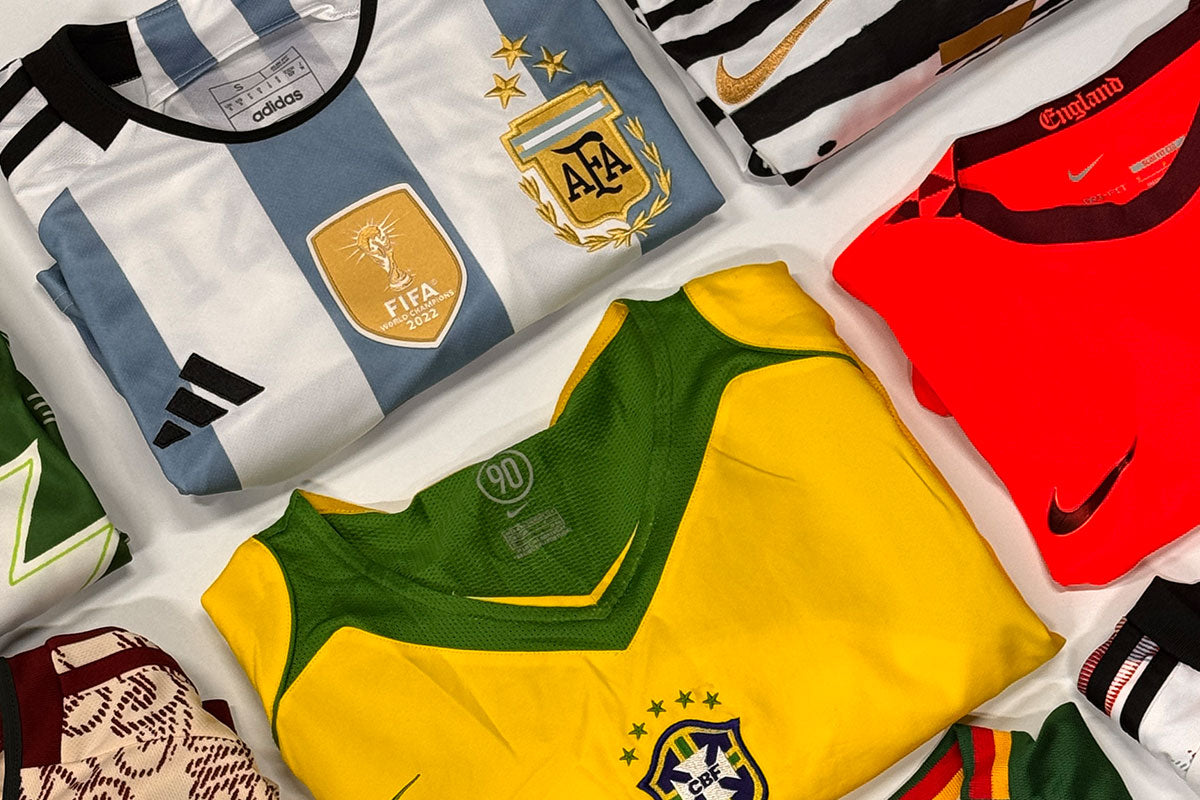
The market for Brazil World Cup shirts has strengthened consistently over the last decade. Brazil's 24-year wait for a sixth title makes the 1994 and 2002 winning shirts particularly significant pieces, and the 1970 Topper original remains the most coveted Brazil shirt in any condition. For collectors who want the discovery element, MJK's World Cup 2026 Mystery Football Shirt Box includes Brazil as one of the 48 competing nations in the rotation, with shirts from 2020 onwards drawn from the launch range for the tournament. The box is launching for the 2026 World Cup at £49.99, with one authentic national team shirt per box from any of the 48 nations playing in North America this summer.
2026 - What Brazil Are Wearing in North America
Brazil's 2026 World Cup home kit is a deliberately classic Nike design. The canary yellow base returns with green trim around the collar, cuffs and side panels. Five stars sit above the CBF crest. There is no radical reimagining, no heritage gimmick, no attempt to do anything new. Brazil are doing what Brazil have always done with their World Cup home shirt: trusting the colour and the crest and the weight of history to do the work.
The away shirt has taken more creative latitude, swapping the traditional palette for a deep navy base with electric blue graphics running across the shirt. Brazil's away shirts have historically been where their experimental design instincts emerge, and the 2026 away continues that tradition.
Notably, Brazil's initial 2026 kit was scrapped after fan backlash to early leaks. The released version is the result of a genuine design revision. That responsiveness to supporter opinion is itself notable, and the final shirts are considerably stronger than the rejected originals. Vinicius Jr leads one of the most exciting Brazil attacking squads in a generation, and demand for the 2026 shirts has been the highest for any Brazil kit in over a decade. The full World Cup 2026 collection includes the home and away kits for all 48 competing nations alongside MJK's curated retro World Cup range.
The Greatest Brazil World Cup Shirt Ever Made
If the question is design alone, the 1970 Topper home shirt is the answer. It is the kit that defined the Brazil visual identity for the next fifty-five years, worn by the greatest international football team in history, and it has barely been improved upon since. If the question is collector value, the 1970 original in good condition is also the answer: original Topper examples are genuinely scarce and command the highest prices in any Brazil shirt category.
If the question is cultural significance specifically, the 2002 Nike home shirt has a case. It is the shirt of the fifth star, the Ronaldo redemption, the most recent Brazil tournament victory. For a generation of fans who grew up watching the 2002 World Cup, that shirt carries the same weight that 1970 carries for older supporters. The 1994 Umbro home runs both close as the most accessible iconic Brazil shirt, and the 1982 home as the shirt of the most beloved Brazil team that never actually won.
For most serious collectors, the ranking is 1970 first, 1994 second, 2002 third, with 1982 entering the conversation purely on the grounds of the team that wore it. But the honest answer is that Brazil World Cup shirts have an internal hierarchy that depends entirely on which tournament defined your relationship with football.

Getting a Brazil World Cup Shirt in 2026
The collector market for Brazil World Cup shirts spans a wide range of price points. The 1970 Topper original sits at the top: genuinely rare, historically significant, expensive at auction. The 1982 home and 1994 Umbro home are next, both still findable in good condition through specialist retailers and collector marketplaces, at prices that reflect their cultural importance without reaching the 1970 peak. The 1998 and 2002 Nike home shirts remain the most accessible iconic Brazil pieces for collectors building their first World Cup shirt collection.
For collectors who want the discovery element rather than the deliberate purchase, the dedicated 2026 World Cup box includes Brazil as one of the 48 nations in the rotation, with all shirts sourced from the 2020 onwards range. The 2026 Brazil home shirt is part of the launch range. MJK has shipped more than 100,000 boxes to date and the global supply network spans 53 countries, meaning Brazil shirts feature consistently throughout the rotation, particularly during a World Cup window when demand for the yellow rises sharply.
Brazil sits among the three most-pulled nations across the MJK mystery box rotation, alongside England and Argentina. That demand reflects something specific about Brazil collectors: the yellow shirt tends to be bought by people who already own one. The second Brazil shirt is often the one that turns a casual fan into a serious collector, because the question stops being "do I have a Brazil shirt?" and becomes "which Brazil era do I want to own next?" The MJK rotation feeds that progression precisely because the boxes do not let the customer choose, which is how someone who walked in for a 2022 Brazil shirt ends up with a 1998 Brazil shirt and starts thinking about 1994.
One MJK customer ordered a mystery box during the 2022 World Cup and pulled out a Brazil 2002 home, a shirt they had wanted for years but had never quite committed to buying directly. They watched the entire knockout stage wearing it. Eight months later they ordered a retro Brazil 1970 from the MJK retro collection. The box created the relationship that the deliberate purchase later completed, which is a pattern MJK sees repeatedly through tournament windows.
For specific shirts from particular tournaments, MJK's retro and international shirt collection is the place to browse, with authenticated Brazil shirts from multiple eras appearing in the rotation. Every shirt in the MJK collection, whether retro or mystery box, is authenticated before it ships.
As seen on BBC Dragons' Den. Mystery Jersey King appeared on BBC Dragons' Den and secured investment from Sara Davies. Every shirt in the MJK collection is authenticated. Read the full story here.
Related World Cup reads
Frequently Asked Questions
What is the best Brazil World Cup shirt ever made?
The 1970 Topper Brazil home shirt is the most consistently cited as the greatest Brazil World Cup shirt ever made. Worn by the team many consider the greatest in football history, with Pele at his peak alongside Jairzinho, Rivelino and Tostao, the shirt established the visual template for every Brazil home shirt of the next fifty-five years. Original Topper examples from 1970 are extraordinarily rare and command the highest prices in any Brazil shirt category.
How many World Cups have Brazil won?
Brazil have won the FIFA World Cup five times, more than any other nation: 1958 in Sweden, 1962 in Chile, 1970 in Mexico, 1994 in the United States, and 2002 in South Korea and Japan. Five stars sit above the CBF crest on the Brazil shirt to represent these victories. Brazil have not won the World Cup since 2002, a 24-year drought that ends or extends in North America this summer.
Which Brazil World Cup shirt is most valuable to collectors?
Original 1970 Topper Brazil home shirts in good condition are the most valuable Brazil World Cup shirts in the collector market, commanding prices that reflect both the historical significance of the tournament and the genuine scarcity of surviving originals. The 1994 Umbro and 2002 Nike World Cup winning shirts are next in the hierarchy, both still findable in good condition at prices that reflect their cultural importance.
What is the Brazil 2026 World Cup shirt design?
Brazil's 2026 World Cup home shirt is a Nike design that returns to the classic canary yellow with green trim around the collar, cuffs and side panels. Five stars sit above the CBF crest. The away shirt swaps the traditional palette for a deep navy base with electric blue graphics. Brazil's initial 2026 kit was scrapped after fan backlash to early leaks, with the released version representing a significant revision. Vinicius Jr leads one of the most exciting Brazil squads in a generation.
Who designed Brazil's classic 1970 World Cup shirt?
The 1970 Brazil World Cup shirt was made by Topper, the Brazilian sportswear brand that clothed the Selecao from the 1950s into the early 1980s. The shirts of this era were often made almost by hand, with patterns cut manually and crests sewn on individually. Topper would continue to produce Brazil shirts until the early 1990s, when Umbro took over for the 1994 World Cup.
Can you get a Brazil World Cup shirt in an MJK mystery box?
Brazil is one of the 48 nations included in MJK's World Cup 2026 Mystery Football Shirt Box, launching for the tournament at £49.99 with one authentic national team shirt from any of the 48 competing nations, with shirts from 2020 onwards. For specific retro Brazil shirts from past tournaments, MJK's retro collection features authenticated Brazil shirts from multiple eras drawn from a global supply network spanning 53 countries.
Why does Brazil wear yellow?
Brazil have not always worn yellow. After their 1-2 defeat to Uruguay in the 1950 World Cup final on home soil, an event still referred to in Brazilian football as the Maracanazo, the Brazilian Football Confederation held a national competition to redesign the shirt. The winning design used the four colours of the Brazilian flag: yellow, green, blue and white. Yellow has been Brazil's home shirt since 1954 and remains one of the most recognisable colours in world football.
Brazil ended 24 years of waiting in 1994. Will they end 24 more this summer?
The 1994 shirt became iconic the moment Romario lifted the trophy. The 2026 shirt is on the way to North America right now. £49.99 buys the chance that the next great Brazil World Cup shirt is the one that arrives at your door before kick-off.
- World Cup 2026 Mystery Football Shirt Box, £49.99 - 48 competing nations
- Retro and international shirt collection
- Men's mystery football shirt box, from £37.99
- Women's mystery football shirt box, from £29.99
- Kids' mystery football shirt box, from £24.99
- Share boxes, 3, 5 or 10 shirts


Leave a comment
This site is protected by hCaptcha and the hCaptcha Privacy Policy and Terms of Service apply.