
The short version
The first 48-nation World Cup produced more shirts than any tournament in history and a set of stories to match. Spain won it in red and gold. Argentina wore the best-designed kit and lost the final. Brazil and Germany both missed the last eight for the first time ever. And the shirts that mattered most by the end were rarely the ones anyone was talking about in June.
In this article
The Biggest World Cup Ever Played
Forty-eight nations, three host countries, and more than 96 different kits before goalkeeper and third shirts were counted. The 2026 World Cup was the largest football tournament ever staged, and for anyone who cares about shirts it was the richest field of designs the game has produced. Nations appearing at a first World Cup arrived with kits nobody outside their borders had seen. Established giants used the occasion for statements, tributes and, in one case, a goodbye to a manufacturer partnership that had lasted generations.
Now that it is over, the summer sorts itself into a shape. Some shirts were beautiful in June and irrelevant by July. Others were ordinary until a single night gave them meaning nobody could have designed in. This is the tournament told through the kits, from the one that lifted the trophy to the ones that went home early and will be remembered anyway.

The Champion: Spain in Red and Gold
Spain won the 2026 World Cup, beating defending champions Argentina 1-0 after extra time in the final at MetLife Stadium, Ferran Torres scoring the goal that decided it. It is their second world title, sixteen years after the first, and it made them the first nation to hold the men's and women's World Cups at the same time.
The shirt they did it in is a lesson in restraint: a deep red Adidas home with thin vertical yellow pinstripes drawn from the flag and crest, navy sleeves, and Three Stripes in red-yellow-red. It never chased novelty, and in a tournament full of ambitious concepts it simply got the fundamentals right. The run behind it was extraordinary in a quieter way too. Spain conceded a single goal across the entire tournament, beating Portugal 1-0, Belgium 2-1 and France 2-0 in the semi-final before shutting out Messi's Argentina in the final. We have written about that shirt in full in the shirt that won the 2026 World Cup.
The Best-Designed Shirt Did Not Win
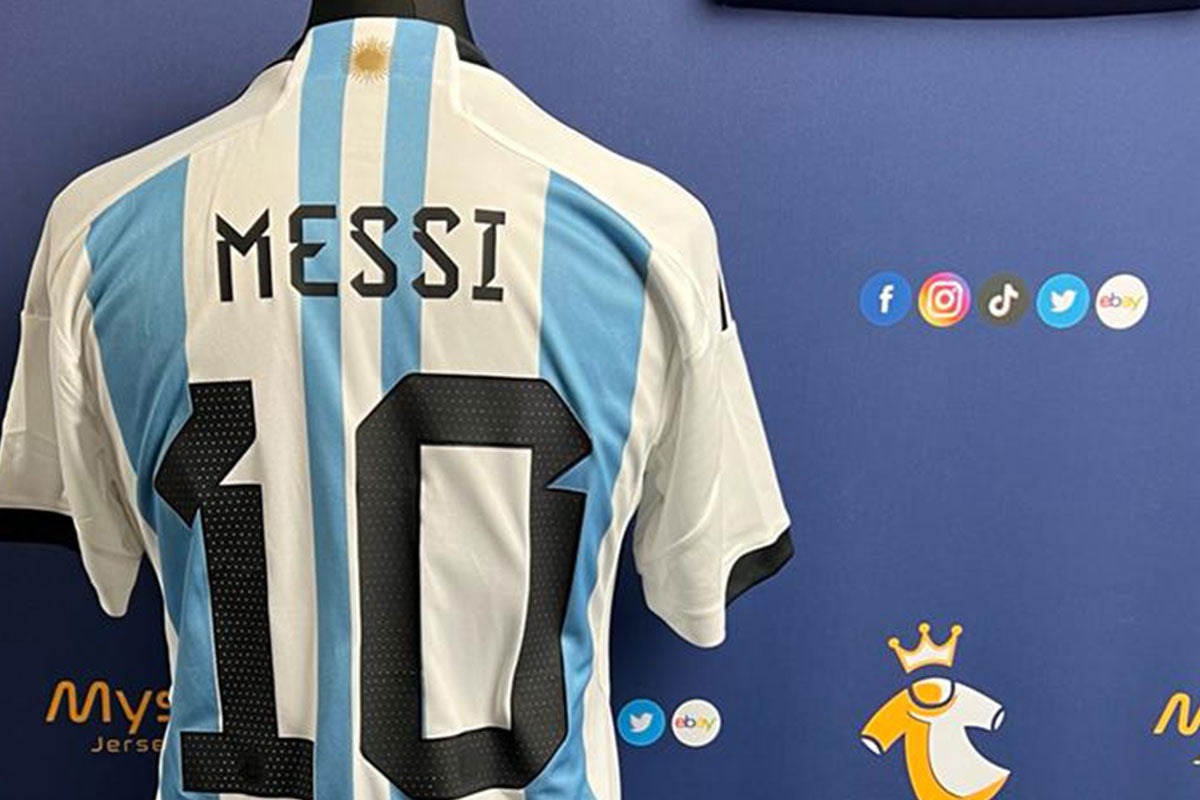
It rarely does. Argentina's three-tone gradient home was the consensus best design of 2026 before a ball was kicked and stayed there all summer: the traditional sky-blue and white stripes rendered as a subtle gradient, one shade for each of their World Cup wins, with a gold crest for the holders. It reached the final and lost. That does not diminish it. If anything the tournament added to it, because Lionel Messi scored eight goals in it and broke the all-time World Cup scoring record along the way.
This is the permanent tension in ranking kits, and it is worth being honest about. Design earns a shirt its place. Results decide whether anyone still talks about it in ten years. Argentina 2026 is that rare case where the design is strong enough to survive the result, which is why it still tops our 2026 World Cup kit tier list on pure design even though Spain owns the trophy.
The Giants Who Fell
The defining structural story of 2026 is a record nobody wanted: for the first time in World Cup history, neither Brazil nor Germany reached the last eight. Brazil, wearing a deeper yellow designed as a tribute to the 1970 side, were beaten 2-1 by Norway. Germany went out before the quarter-finals in the final kit Adidas will ever produce for them, ending one of the longest partnerships in the sport at a tournament they could not get out of.
Both shirts were excellent. Both are now attached to disappointment, and both, counterintuitively, gain a certain collectability from it. A farewell kit that ends in an early exit is still a farewell kit, and the last Adidas Germany shirt will be a reference point for decades. Meanwhile France reached the semi-finals in the most conceptually ambitious kit of the tournament, a glacier-green away honouring the Statue of Liberty, beating Morocco 2-0 along the way, before Spain ended their run and England beat them 6-4 in an extraordinary third-place match.

The Shirts the Tournament Made
Every World Cup takes a handful of unremarkable kits and hands them permanent significance, and 2026 was generous with them.
Norway. A clean, understated shirt that will now forever be the one that knocked Brazil out of a World Cup, winning 2-1. No design brief achieves that.
Scotland. A restrained, heritage-faithful navy that became something else entirely the moment Scotland won their first World Cup match in 28 years wearing it. Ask any Scotland supporter which shirt they want and the answer is now obvious.
England. The white with the gold star was already the most-worn shirt in Britain. It goes into the archive as the kit of a run to the semi-finals, past Mexico 3-2 and Norway 2-1, with Jude Bellingham scoring twice against Norway and four times across the tournament, followed by a 6-4 third-place win over France. Best finish since 1966.
Cape Verde and Curacao. Two of the smallest nations ever to reach a World Cup, arriving with debut shirts made in tiny quantities. Scarcity plus a genuine first equals the kind of collector interest that only grows.
A Farewell and a Record
The emotional centre of the tournament was Lionel Messi, in what is almost certainly his last World Cup. He scored eight goals, broke the all-time World Cup scoring record, and carried Argentina through knockout ties against Egypt, won 3-2, and Switzerland, won 3-1, before the final ended one goal short. Kylian Mbappe finished the tournament as the World Cup's new all-time leading scorer, which is its own marker of an era changing hands.
Shirts attached to a great player's final tournament acquire a permanence that ordinary kits never do, because the moment cannot be repeated. That is a large part of why Argentina's 2026 home is the shirt most likely to hold its value from this summer, an argument we set out in full in which 2026 World Cup shirts will be worth the most in 10 years.
Every tournament, the shirts people ask us for in August are different from the ones they asked for in May. A kit nobody rated becomes the one everybody wants, because of one night. That is the part you cannot plan for, and it is the best part of this job.
- Jamie King, co-founder, Mystery Jersey King
What Lasts, and What Does Not
Two of the finest designs of the tournament never made it out of the group stage. South Korea's hidden-tiger home, with a white tiger woven into the fabric in tonal camouflage, was the most admired kit of the summer among people who look closely at shirts. Japan's rainbow-pinstriped away was among the most coveted. Neither reached the knockouts, and both will be remembered longer than plenty of kits that went further.
That is the honest verdict on kit design: excellence survives elimination, but significance requires results. The shirts that endure longest tend to have both, which is why Spain 2026 and Argentina 2026 will outlast the rest of this field, and why 2026 was also the first World Cup where goalkeepers received bespoke national designs rather than templates, producing some of the boldest shirts of the whole tournament.
The Full 2026 Archive
Everything we published across the tournament now sits as a permanent record. The 2026 World Cup kit tier list ranks every shirt from S-tier to D-tier and was updated through every round until the final settled it. The shirt that won the 2026 World Cup covers the champion's kit in detail. Which 2026 shirts will be worth the most in 10 years takes the collector's long view.
And for the kits these designs kept quoting from, the classics of 1970, 1986, 1998 and beyond, the best retro football shirts of all time is where that story starts.
Owning a Piece of It
If the summer has left you wanting a shirt, there are two honest routes. Buy the specific kit you want, deliberately, from a specialist retailer. Or let the shirt choose you.
An MJK mystery box sends one genuine football shirt without you knowing which one is coming: any club, any nation, any era, drawn from a supply network spanning more than 50 leagues and 53 countries. That second route is closer to how this tournament actually worked. Almost nobody had Norway beating Brazil, or Scotland winning for the first time in 28 years, and the shirts that ended up mattering were mostly the ones nobody chose in advance. For the classic kits of past tournaments, the retro football shirts collection covers the eras 2026 kept referencing.

As seen on BBC Dragons' Den. Co-founder Alex Street pitched Mystery Jersey King solo on Series 22, and Sara Davies MBE invested £50,000 for 15%. Read the full story here.
Related reads
Frequently Asked Questions
Who won the 2026 World Cup?
Spain won the 2026 World Cup, beating defending champions Argentina 1-0 after extra time in the final at MetLife Stadium on 19 July, with Ferran Torres scoring the winner. It was Spain's second world title after 2010, and they conceded only one goal across the entire tournament.
What was the best shirt of the 2026 World Cup?
On design, Argentina's three-tone gradient home was the consensus best shirt of the tournament: the traditional sky-blue and white stripes rendered as a subtle gradient, one shade for each of Argentina's World Cup wins. South Korea's hidden-tiger home and France's Statue of Liberty away were the other standout designs.
How many kits were there at the 2026 World Cup?
With 48 nations each producing a home and away shirt, there were more than 96 different kits, rising past 100 once goalkeeper and third shirts are counted. It was the largest set of tournament shirts ever produced, a direct consequence of the expanded 48-team format.
Did Brazil and Germany really both miss the quarter-finals?
Yes. For the first time in World Cup history, neither Brazil nor Germany reached the last eight. Brazil were beaten 2-1 by Norway, and Germany went out before the quarter-finals in what was the final kit Adidas will ever produce for them, ending one of the longest partnerships in football.
How did England do at the 2026 World Cup?
England reached the semi-finals, beating Mexico 3-2 and Norway 2-1 on the way, with Jude Bellingham scoring twice against Norway and four times across the tournament. They then beat France 6-4 in the third-place match, their best World Cup finish since winning the trophy in 1966.
Why do some shirts become collectable after a tournament?
Significance drives value more than design does. A shirt tied to a first-ever win, a legend's final tournament or a trophy lift carries a story that never fades, and scarcity compounds it: debut nations produce far smaller runs than the giants. That is why an ordinary-looking kit can outlast a beautifully designed one that went home early.
How does a mystery football shirt box work?
You pick your size, and Mystery Jersey King picks the shirt. One genuine football shirt arrives without you knowing which one is coming: any club, any nation, any era, drawn from a supply network spanning more than 50 leagues and 53 countries. MJK has shipped over 100,000 orders and is rated 4.7 out of 5 from more than 1,000 reviews.
Mystery Jersey King
The Tournament Is Over. The Shirts Are Forever.
Nobody picked Norway to beat Brazil. Every MJK box works the same way: one genuine football shirt through your door without you knowing which one is coming, any club, any nation, any era.
100,000+ orders shipped. Rated 4.7/5 from 1,000+ reviews. Shipping to 53 countries. As seen on BBC Dragons' Den.


Leave a comment
This site is protected by hCaptcha and the hCaptcha Privacy Policy and Terms of Service apply.